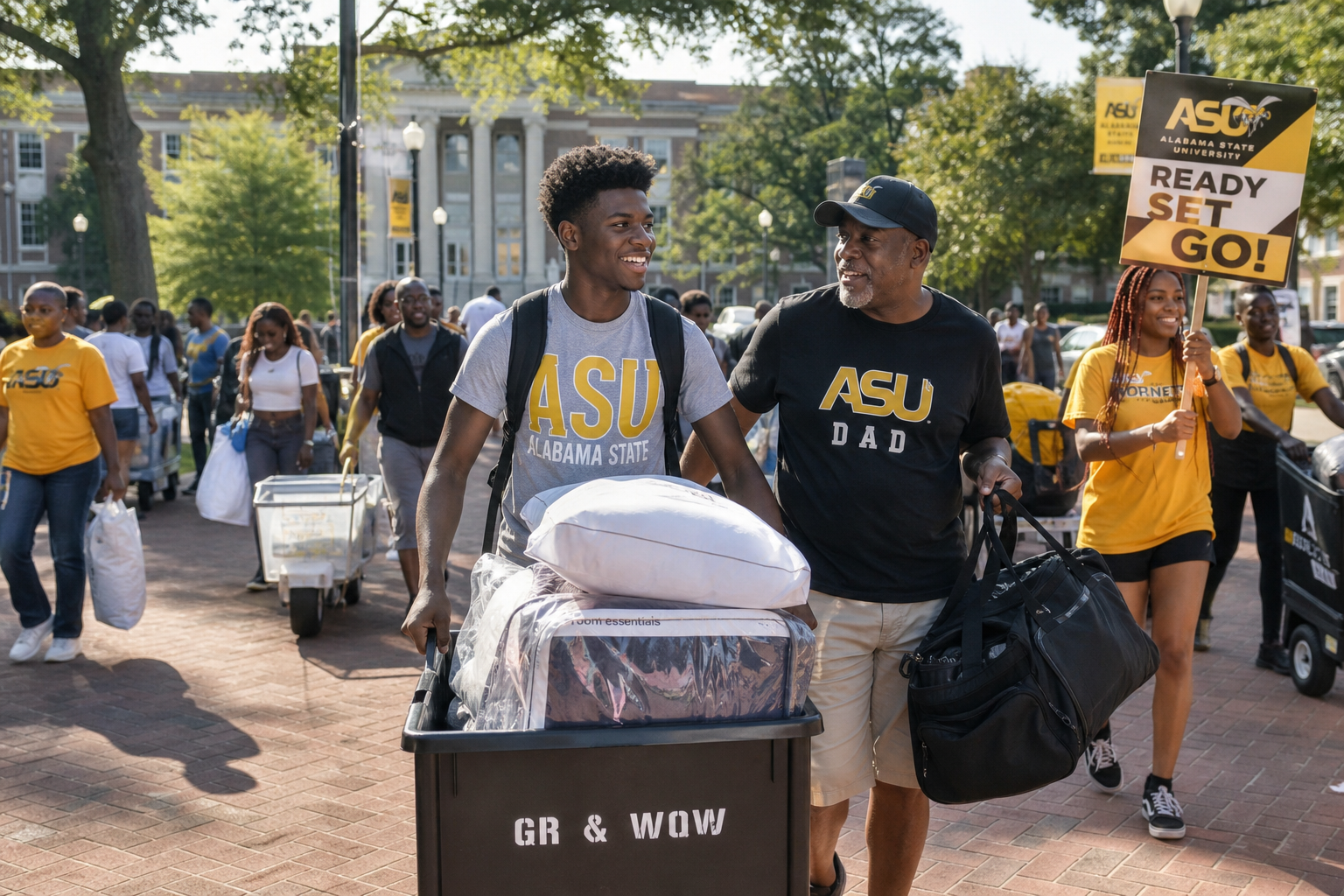
Across more than one hundred Historically Black Colleges and Universities, the mid-August quiet has broken. Freshman move-in days, New Student Orientation, and Welcome Week traditions are launching the 2026–2027 academic year, and campuses that spent the summer on a low hum are loud again — carts on brick walks, parents on the sidewalk, and the first drumline cadences rolling off the practice field.
This is the week the Class of 2030 arrives. At Howard University in Washington, D.C., Bison Week and the pinning ceremony introduce first-year students to the campus as a living community, not just a set of residence halls. In Tallahassee, Florida A&M University is bringing new and returning Rattlers back onto the Highest of Seven Hills. In Atlanta, Morehouse College is opening the year with its Welcome to the House assembly and Parent Parting Ceremony — rites that tell incoming students they are being received into a brotherhood, not dropped at a dorm door.
The same season is unfolding at Virginia Union University, Hampton University, Savannah State University, and North Carolina A&T State University, where convocations and orientation weeks place new students inside an institutional story older than any one class. The details differ by campus. The charge is shared: you are not starting from zero. You are stepping into a lineage.
What makes an HBCU opening week distinct is how much of it happens in public. Greek organizations bring step shows onto the yard. Marching band drumlines give the week a tempo. Family cookouts turn the quad into a reunion. Faculty mentorship is not a later add-on; it is part of the welcome, sitting beside the music and the food so academic purpose is named in the same breath as belonging.
Move-in itself is part of that pedagogy. Student orientation leaders, upperclassmen, and campus staff meet families at the curb. The work is practical — bins, keys, room assignments — and it is also a first lesson in how these campuses take care of their own. For students leaving home for the first time, that first afternoon on the yard is often the moment the institution stops being a name on a decision letter and becomes a place.
Welcome Week is doing the rest of the translation. New Student Orientation walks first-years through the academic and social map: where to find help, how the campus actually works, and what it means to represent the school after the last parent car pulls away. The week is designed to ground the Class of 2030 in community before the first syllabus is read, so the year begins with people, not just a schedule.
The return also arrives at a demanding time for the sector. Housing is tight on many campuses. Federal support for HBCUs remains a live policy question. Demand for seats, aid, and student services is high. Those pressures do not cancel the meaning of this week. They explain why the welcome has to be more than a party — why mentorship, convocations, and family presence still sit at the center of how these schools open a year.
By the time classes begin, the Class of 2030 will have been walked, fed, pinned, and claimed. That is the point of an HBCU Welcome Week. The yard is not a backdrop. It is the first classroom.
Why this matters: The first week back is how HBCUs turn a new class into a community. Move-in, pinning, convocations, and Welcome Week give the Class of 2030 a public place in a living tradition — and they remind the wider HBCU world that these campuses remain unmatched at making belonging and academic purpose arrive on the same day.