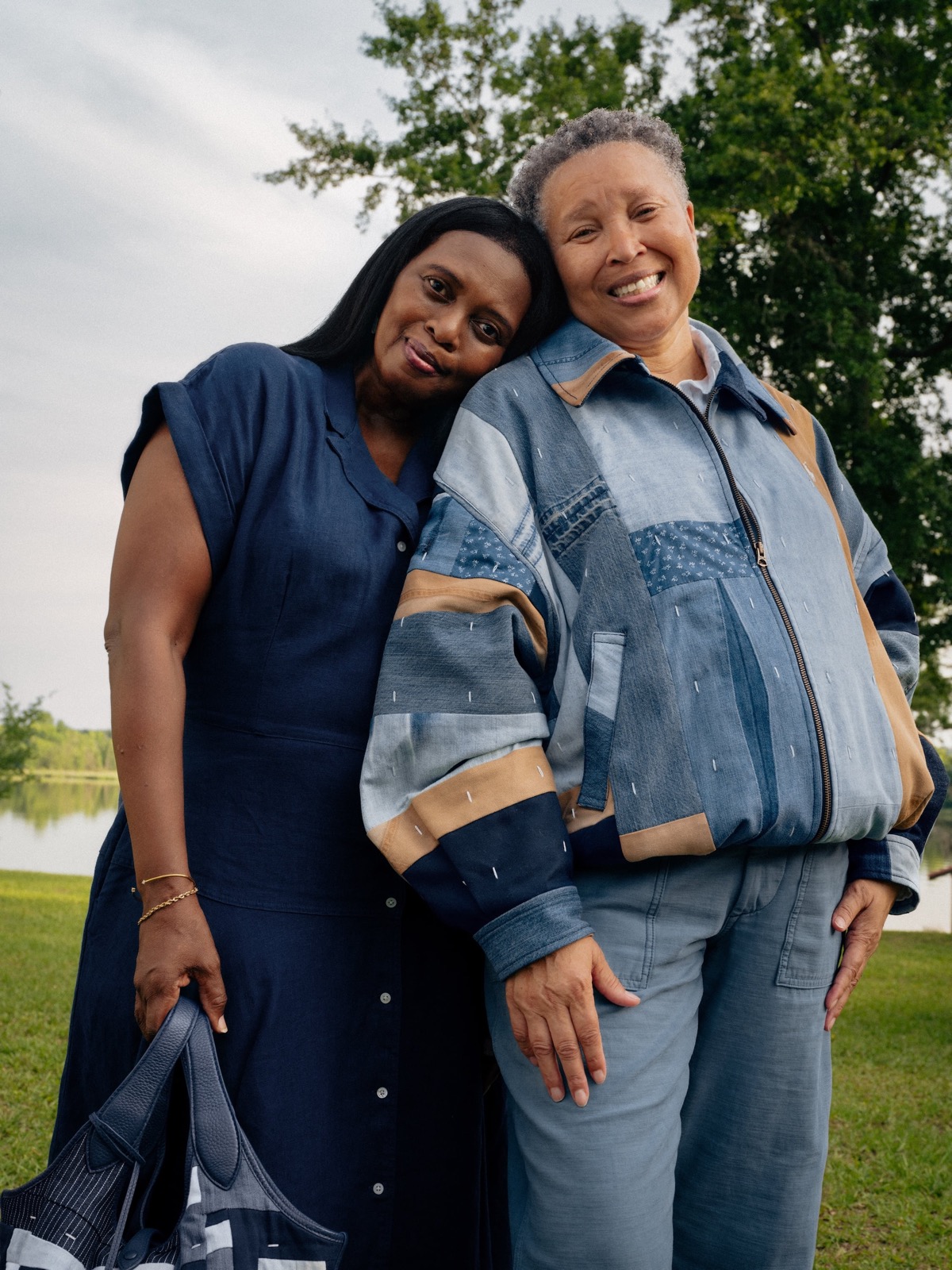
Gee’s Bend is a small Alabama community on a bend of the Alabama River whose quilts museums already treat as American modernism — improvisational geometry, leftover cloth, a visual language built by Black women across more than a century. On July 28, that language walked into Polo.
Ralph Lauren launched Ralph Lauren x Gee’s Bend, the fifth collection in its Artist in Residence program, with textile artists Claudia Pettway Charley, a fourth-generation quilter, and Loretta Pettway Bennett, a fifth-generation quilter. The limited drop is ten pieces of apparel and home: upcycled Ralph Lauren fabrics, hand-pieced construction, visible topstitching, and denim as the bridge between workwear and luxury. Prices run from a mug set at $225 to a hand-stitched jacket at $4,998. Hand-painted tableware, made in Italy with Ralph Lauren Home’s partners, is cut with the same intentional asymmetry as the quilts.
The storytelling is specific. Pettway Bennett’s red triangles honor her sons. Pettway Charley’s color and composition stay improvisational — the same instinct that made Gee’s Bend quilts impossible to mistake for pattern-book craft. Five percent of each purchase goes to the Equal Justice Initiative in Montgomery, for hunger relief across Alabama, including Gee’s Bend.
For HBCU readers this is not a celebrity collab recap. Polo is campus vernacular. It has been on the yard, at homecoming, in Divine Nine portraits, and in the closet of every generation that used prep as armor. Gee’s Bend is the other half of that American story: Black women in Alabama turning necessity into high art long before a New York house put a hangtag on it. Alabama’s HBCUs sit in the same cultural geography. The question the drop raises is the one the Fashion and Arts desks should keep asking: who gets credited, who gets paid, and whether “inspiration” has finally become collaboration.
The collection is on RalphLauren.com, in the Ralph Lauren app, and at select stores. North America went on sale July 28; the rest of the world on July 30.
Why this matters: Fashion and visual art are how HBCU identity travels off campus. A Polo collaboration that names Gee’s Bend artists — and sends money to EJI — is a culture story, not a shopping blurb.